
Local roofing in Houston
Houston roofs take a beating from Gulf storms, hail, and the straight-line winds that follow spring squall lines. The May 2024 derecho drove gusts near 100 mph across the metro, tearing shingles, downing trees, and leaving more than 900,000 CenterPoint customers without power. Housing stock ranges from postwar bungalows in older wards to new construction out west, so roof ages and decking condition vary block to block across ZIPs like 77002, 77008, and 77042. Aging composition roofs near town often hide soft decking and worn flashing, while newer builds fail early at valleys and pipe boots. We are on roofs in Houston every week, and we know how differently a Montrose cottage and a Westchase two-story respond to the same storm.
Neighborhoods we serve in Houston
We’re on roofs across Houston every week, including:
HOA & permitting in Houston
The City of Houston requires permits for reroofing and inspections vary by structure type and slope. Many master-planned pockets and townhome communities also enforce HOA color and material rules, so we confirm both before work starts.
The Storms That Define a Houston Roof's Life
Houston does not get one kind of weather. It gets all of them, and each one attacks a roof differently. Hurricane Harvey in 2017 buried the city in rain and exposed every weak valley and worn flashing detail across town. The May 2024 derecho brought a different threat entirely: straight-line winds near 100 mph that stripped shingles, blew out downtown skyscraper windows, and knocked power out for the better part of a week. Then there is spring hail, which rolls in with squall lines and bruises shingles across the whole metro.
That mix means a Houston roof rarely dies of old age alone. It dies when a big wind event finds a tab that was already lifting, or when hail cracks a shingle that was already brittle from years of Gulf Coast sun. We are on roofs in Houston every week, and the damage we document is usually the storm finishing off a weakness that was already there.
The takeaway for homeowners is simple: in Houston, roof condition is a moving target. What passed inspection two springs ago may not survive the next derecho or hail round, which is why we document the current state of the roof, not last year's.
One City, Many Roofs: How Age and Style Change the Job
Greater Houston is not a single roofing market. Near-town neighborhoods like Montrose, the Heights, and the older wards carry early-1900s to mid-century homes with steep original framing, layered shingles, and skip-sheathing that behaves nothing like modern decking. These roofs need careful hands and a real understanding of how water moves through an old gable.
Out west toward Memorial, Westchase, and the Energy Corridor, the housing shifts to 1970s and 1980s ranch homes and newer construction. Those composition roofs are often at or past their service life, and the newer builds tend to fail first at complex valleys, dormers, and pipe boots. Downtown and near-town, low-slope and flat sections on older commercial-style homes are a recurring leak point after heavy rain.
Because the roof you own depends entirely on which part of Houston you live in, there is no one-size answer. We match the approach to the structure, whether that is detailing a century-old Heights valley or replacing a tired Westside two-story.
City of Houston Permits and Why They Matter
The City of Houston requires a permit for reroofing, and the requirements can change based on slope and structure type. A steep-slope composition reroof is handled differently than a low-slope or flat section, and skipping the permit is a shortcut that can come back to bite you at resale or on an insurance claim.
We handle the permitting so you do not have to, and we confirm any additional rules that apply. Plenty of Houston pockets, from townhome communities to master-planned enclaves, enforce their own HOA color and material standards on top of the city permit. We check both before the first shingle comes off.
It is worth knowing that some near-town neighborhoods also fall under historic district rules that affect roofing visible from the street. We flag that up front so there are no surprises mid-project.
What to Check Before You Call a Roofer in Houston
First, know your roof's age and what it has been through. If your roof was on the house during Harvey or the 2024 derecho, it has already been stress-tested, and any weakness that survived is worth a fresh look. Age plus storm history tells you more than any single glance.
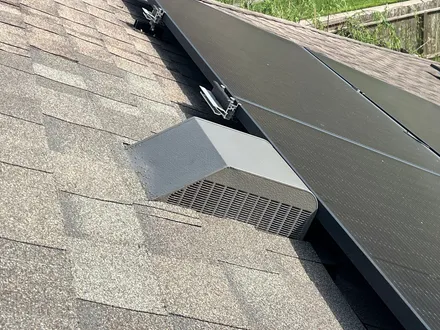
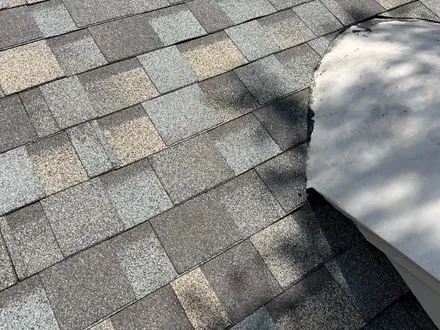
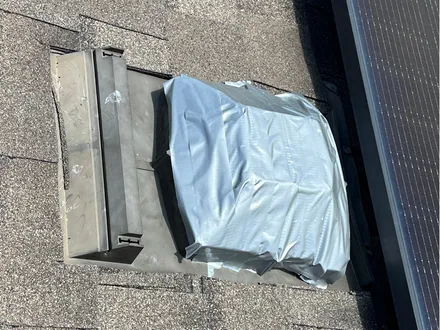
Watch for the common Houston tells: granules washing out at downspouts, dark bruised spots from hail, lifted or missing shingles after a wind event, and interior ceiling stains that show the roof is already leaking. On older near-town homes, pay attention to the transitions between the main gable and any lower-slope additions, since those are frequent leak points.
You do not need to climb up or guess. We schedule a free drone inspection anywhere across Greater Houston, document the roof from the air and on the deck, and hand you a written assessment so you know exactly where you stand before you file anything.